Learn how small businesses can use n8n lead automation to capture enquiries, qualify intent, follow up consistently and turn more conversations into sales opportunities.
Key takeaways
- Map the lead journey before choosing automation nodes.
- Capture every enquiry in one reliable record with consent and source context.
- Use scoring and human review to mature leads instead of blindly sending messages.
- Measure response time, qualification rate and sales outcomes, not just workflow executions.
Why small businesses lose good leads
Most small businesses do not lose opportunities because nobody cares. They lose them because a new enquiry arrives in one of several inboxes, the next step depends on memory and the follow-up happens after the buyer has moved on. A website form may notify one person, a WhatsApp conversation may stay on a phone and a spreadsheet may be updated only when someone has time.
n8n helps connect those separate moments into one visible lead journey. The goal is not to automate every sales conversation or make the business feel robotic. The goal is to remove avoidable delay, preserve useful context and give the team a clear decision about what should happen next.
Start with a lead maturity model
Before building a workflow, define what a lead means at each stage. A practical model for a small business might be new enquiry, contactable, marketing qualified, sales qualified, proposal in progress, won or not a fit. Each stage should have an owner, a next action and a reason for moving forward or stopping.
This simple map prevents a common automation mistake: treating every form submission as a sales opportunity. Someone downloading a guide needs a useful reply and permission-aware nurture. Someone requesting a project estimate needs a faster human response. Someone outside your service area may need a polite explanation rather than a sequence of sales messages.
A practical n8n workflow
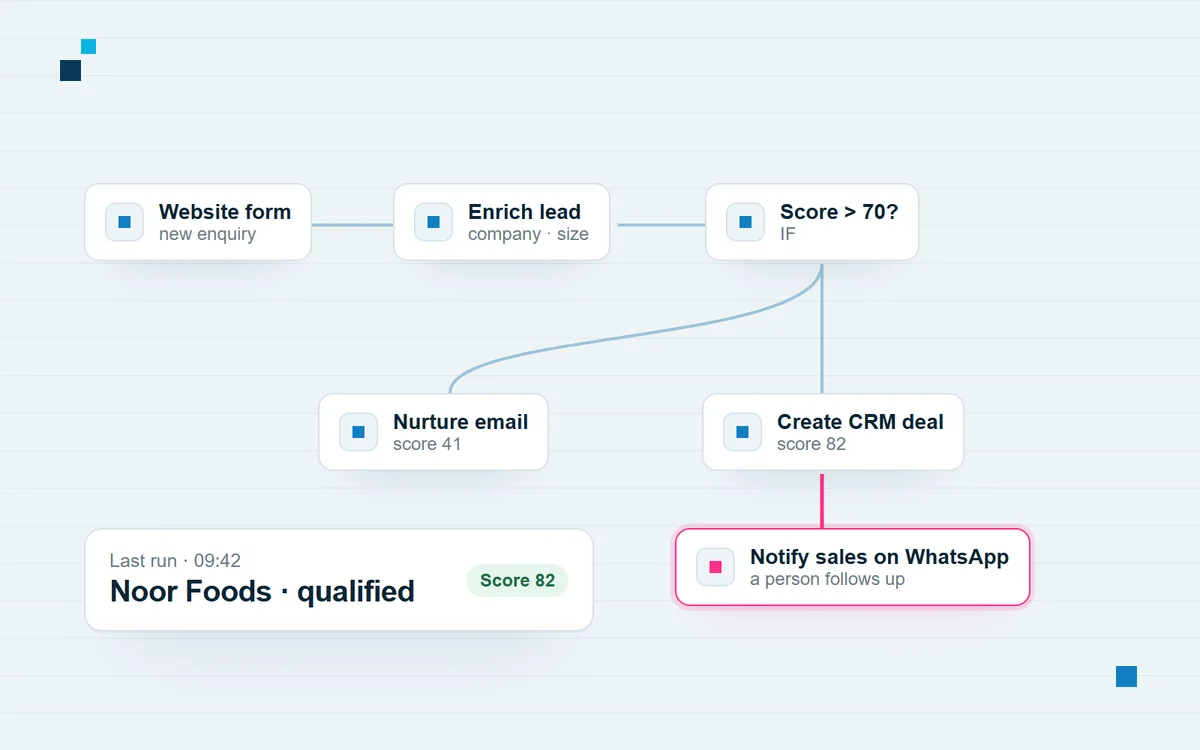
A reliable lead workflow can begin with a form, WhatsApp inbox, email parser or CRM trigger. n8n validates the fields, records the source and timestamp, normalises the phone number and checks whether the person already exists. It then creates or updates one lead record rather than creating duplicates for every interaction.
The workflow can enrich the record with permitted business context, such as the selected service, company size, budget range, timeline and location. A small rules node can score clear signals. A request for a proposal, a defined timeline and a relevant service may raise priority. Missing information should create a task for clarification, not a confident guess from a language model.
After qualification, n8n can route the lead to the right owner, send an acknowledgement with a realistic response time and create a follow-up task. The final step is not a message. It is a durable status that tells the team whether the next action is waiting for a reply, ready for a call, preparing a proposal or closed with a reason.
Where AI helps and where it should not
AI can be useful for extracting intent from an unstructured enquiry, summarising a long email, suggesting a service category or drafting a reply for human approval. In n8n, the model should return a small validated object such as intent, urgency, missing information and suggested next action. The workflow can then apply deterministic rules around that result.
AI should not silently decide pricing, promise delivery dates, approve discounts or send sensitive messages without a suitable review step. Small businesses need automation that is understandable when something goes wrong. Keep the original message, the extracted fields, the model version and the human decision in the lead history so the team can inspect the reasoning later.
Build follow-up that feels personal
Good nurture is timely and relevant, not frequent for its own sake. A new enquiry may receive a confirmation immediately, a useful answer within one business day and a short follow-up when the person has had time to respond. The content should reflect the service they asked about and make the next step obvious.
Use branches instead of one generic sequence. A web development enquiry may receive a discovery checklist. A UI and UX request may receive a short guide to preparing a Figma review. An automation enquiry may receive questions about the current workflow and the systems that need to connect. Always honour consent, provide a clear way to stop messages and pause automation when a person replies or a team member takes ownership.
Connect the tools you already use
n8n is most valuable when it connects the systems around the work. A common small business setup might include a website form, an email inbox, a CRM or database, a calendar, a team notification channel and an analytics destination. Start with the fewest integrations that remove the most friction. A dependable form to CRM workflow is more valuable than a large collection of fragile automations.
Use separate credentials with the minimum permissions each workflow needs. Keep secrets out of node text, log meaningful errors without exposing personal data and add an owner for every production workflow. If a provider is unavailable, the lead should still be stored and a human should know that delivery needs attention.
Measure business outcomes
Workflow execution counts are operational signals, not business results. Track the time from enquiry to first response, the percentage of leads with a next action, the qualification rate by source, the number of booked conversations and the reasons leads are closed. Compare those measures with the time your team spends on manual copying and reminders.
Review the workflow every month. Remove branches nobody uses, improve questions that produce incomplete submissions and add safeguards for new edge cases. Automation becomes mature when the team can explain what it does, recover a failed run and improve it from evidence rather than fear.
A sensible first automation
For many small businesses, the best first project is a focused lead intake and follow-up workflow. Connect the existing enquiry form to one lead record, send an immediate confirmation, notify the right person, create a task with a due time and record the outcome. Add qualification rules only after the team has observed the real data for a few weeks.
This approach creates a useful foundation without forcing a new CRM or a complex AI system on day one. Once the process is stable, n8n can connect proposal generation, calendar booking, document collection, reporting and carefully reviewed AI assistance. The result is a sales process that feels more responsive to buyers and more manageable for the people running the business.
Official documentation
Use the n8n error-handling documentation when planning failure notifications and recovery for a lead workflow. Verify each connected provider’s permissions and API behaviour before enabling external actions.
Related implementation services
Explore custom CRM and lead management development or travel agency automation workflows to connect this guidance with a scoped project.